Burrowcore meets fairytale cottage: house martins swoop across the painted beams of botanical artist and set designer Tattie Isles's 18th-century thatched cottage in West Dorset, which she transformed with her husband Fred. Buttery walls, a red velvet armchair and a hand-painted tree mural complete the storybook escape. Photograph: Dean Hearne for House & Garden.
Remember the homes in the books you loved as a child? Badger's kitchen in The Wind in the Willows, with its fire and its ham hanging from the rafters. The tree-stump houses of Brambly Hedge, every shelf full of jars and teacups. Bilbo's round-doored hole, which meant comfort. None of them had a ceiling light. They glowed from lamps, candles and the fire.
That glow is the heart of burrowcore, the storybook interior trend everyone is talking about this season. More than any piece of furniture, it is a style built on light: low, warm, layered and gently diffused. Get the lighting right and almost any room will start to feel like a burrow.
Below we explain what burrowcore is, how it differs from cottagecore and grandmillennial style, and how to light each room with lamps that feel like they have a story to tell.
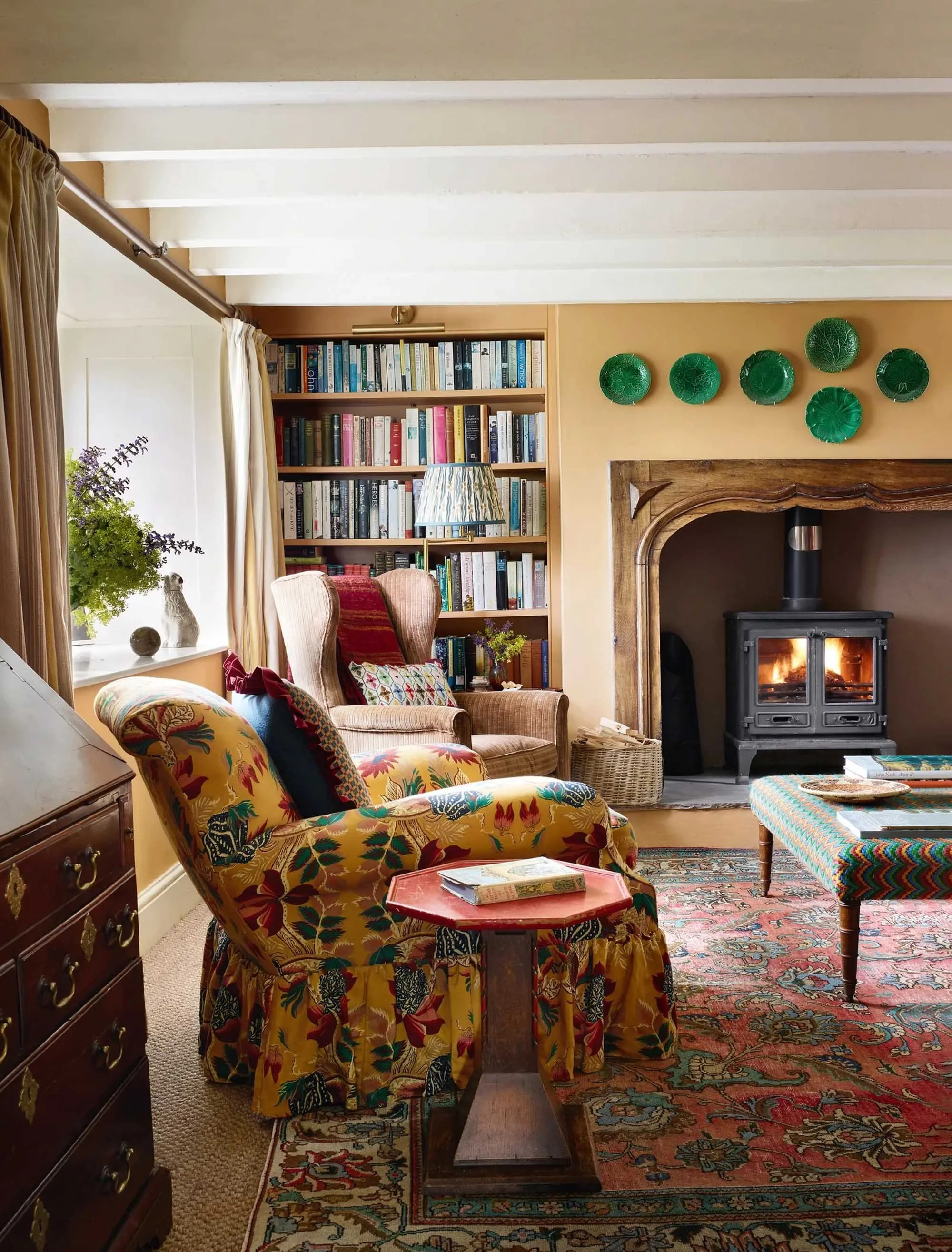
Burrowcore at its coziest: ochre walls, layered florals and a crackling woodburner in interior designer Lucinda Griffith's Welsh cottage sitting room. Photograph: Rachael Smith for House & Garden.
What Is Burrowcore?
Burrowcore is an interior style that makes your home feel like a small animal's burrow from a children's storybook. It is enclosed, warm, layered and lived-in. Think earthy colors, worn wood, soft textiles, shelves full of books and crockery, and warm pools of lamplight instead of a single bright ceiling light. Designer Michelle Gage describes it as:
"A home you can sink into. It’s cozy, layered, and a little cocoon-like; a space that makes you want to stay awhile. The key is surrounding yourself with pieces that feel as good as they look. We’re craving comfort at home more than ever, and Burrowcore takes that feeling of ‘I just want to stay in’ and turns it into a design aesthetic. It’s about creating little pockets of comfort that make everyday life feel calmer – a cozy reading corner, an extra-soft throw, warm lighting or nature-inspired accents.”
Where burrowcore comes from
Burrowcore emerged on social media in 2026. One of the first people to define it was therapist Colette Hallows, whose reels described homes modeled on the burrows of storybook animals (House & Garden). Its references are the classics of cozy illustration: Beatrix Potter, Jill Barklem's Brambly Hedge, Karina Schaapman's The Mouse Mansion and Winnie-the-Pooh. Writer Marta Sader covered the trend for House & Garden and AD España. She pictures the storybook burrow as a fire in the hearth, books and jars on wooden shelves, wingback chairs, heavy curtains, floral wallpaper and a cake on the table.
Interest jumped in autumn 2026. Trend expert Pawel Kruszynski of Promizi told Ideal Home that Google searches for "burrowcore" rose 244.8% from early September. The same piece reported Pinterest searches for "warm lighting" up 66% in a month.
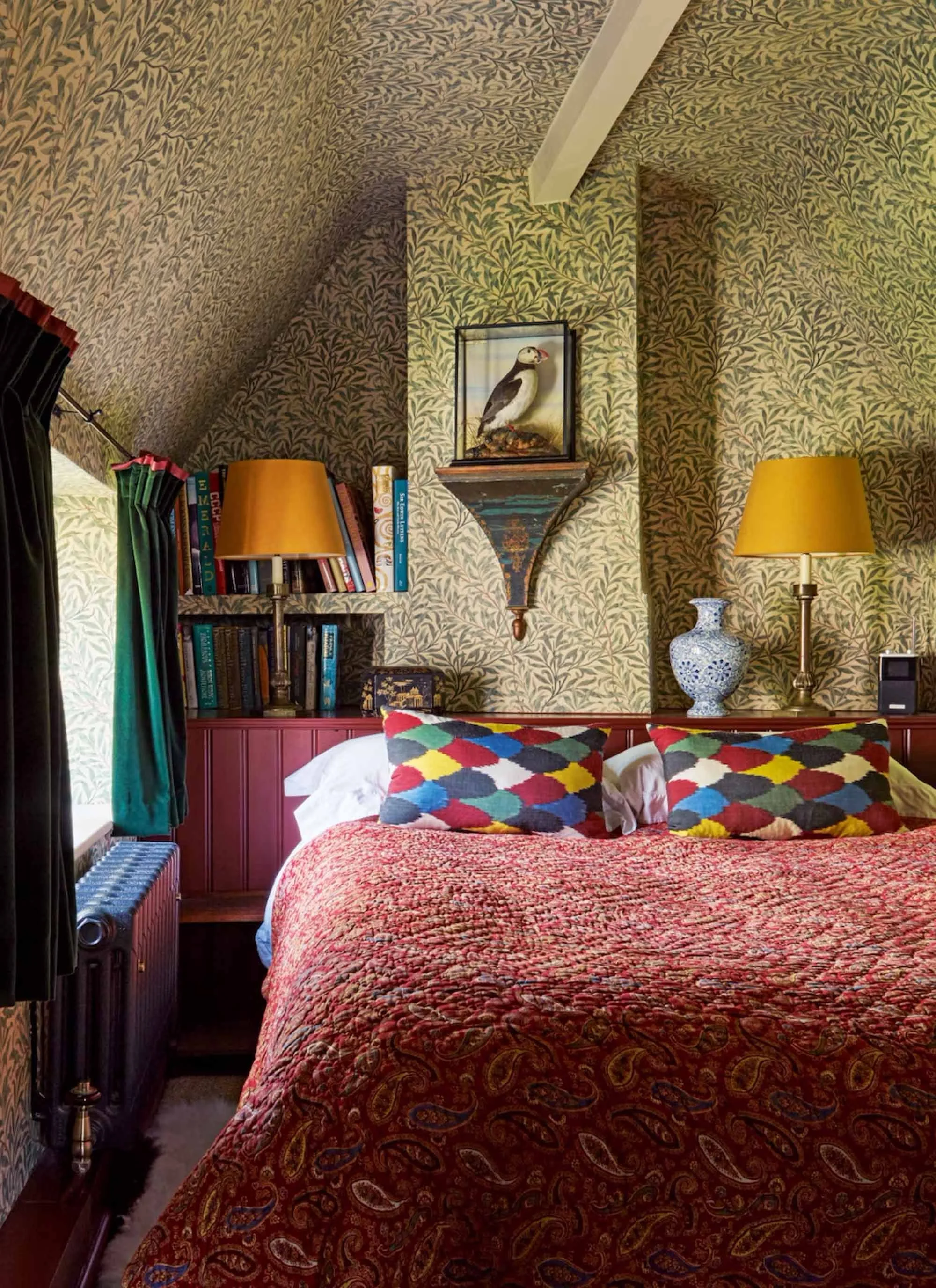
Burrowcore under the eaves: art specialist and interior designer James Mackie wrapped the walls and ceiling of his Cotswold cottage's attic bedroom in Morris & Co's 'Willow Bough', with panelling in Farrow & Ball's 'Deep Reddish Brown' and a paisley quilt in warm, enveloping tones. Photograph: James McDonald for House & Garden.
Why it resonates now
Burrowcore answers a very modern tiredness. Interior designer Rebecca Midden links it to constant screen use, describing a home as a place that should make us feel held and give us a boundary from the outside world (Homes & Gardens). Designer Lara Clarke told House Beautiful that people want home to be "a sanctuary rather than another space to perform in." Burrowcore also rejects the showroom look. Full shelves, mismatched pieces and a little clutter are welcome, as long as the room feels like yours.
That is also why burrowcore suits antique and vintage pieces so well. A burrow is furnished over a lifetime: a grandmother's teapot, a chair from the flea market, a lamp made from a vase with a past. Our handcrafted table lamps are made the same way, from historic European ceramics, using non-invasive methods that leave each vase undamaged.
Burrowcore vs. Cottagecore vs. Grandmillennial
Cottagecore looks outward to the garden, grandmillennial looks back to grandmother's drawing room, and burrowcore looks inward to the fireside. The three styles share a love of nostalgia, pattern and old things. They differ in mood, light and how formal they feel.
| Feature | Burrowcore | Cottagecore | Grandmillennial |
|---|---|---|---|
| Mood | Enclosed, sheltered, introspective | Open, airy, rural | Polished, traditional, a little preppy |
| Inspired by | Storybook burrows: Beatrix Potter, Brambly Hedge, hobbit holes | Country cottage life, gardening, baking, slow living | Grandmother's house: chintz, ruffles, needlepoint |
| Origins | Social media in 2026; therapist Colette Hallows was among the first to define it | Named on Tumblr in 2018; grew during the 2020 lockdowns | Named by Emma Bazilian in House Beautiful in September 2019 |
| Palette | Moss, olive, tobacco, rust, burgundy, ochre | Cream, sage, soft pastels, washed florals | Blue and white, pink, green, confident color |
| Materials | Dark and worn wood, chunky wool, chenille, patchwork | Linen, wicker, gingham, pale painted wood | Chintz, toile, rattan, skirted tables, brass |
| Lighting | Low, warm pools from lamps and candles | Natural daylight, simple pendants | Statement table lamps with pleated or patterned shades |
| Ceramics | Teapots, crockery and stoneware left out on shelves | Hand-thrown jugs and vases of garden flowers | Blue-and-white porcelain, chinoiserie, Delftware |
Colette Hallows puts the difference simply. Burrowcore, she says, is "what cottagecore was trying to be… but without the pressure" (House & Garden). Highly styled cottage rooms take money, time and constant upkeep. Burrowcore welcomes thrift-shop finds and a little everyday mess. House Beautiful sees it as a cozier, more lived-in version of cottagecore, less about recreating a country cottage than making a home you never want to leave. It works just as well in a city apartment.
Grandmillennial style is the most formal of the three. It is still the best fit if you love chintz, chinoiserie and Delftware. Our Ultimate Grandmillennial Style Guide covers it in depth. The styles also mix well: a grandmillennial lamp with a pleated floral shade glows beautifully in a burrowcore reading nook. If you love all three, you're probably a maximalist at heart!
How to Light a Burrowcore Room
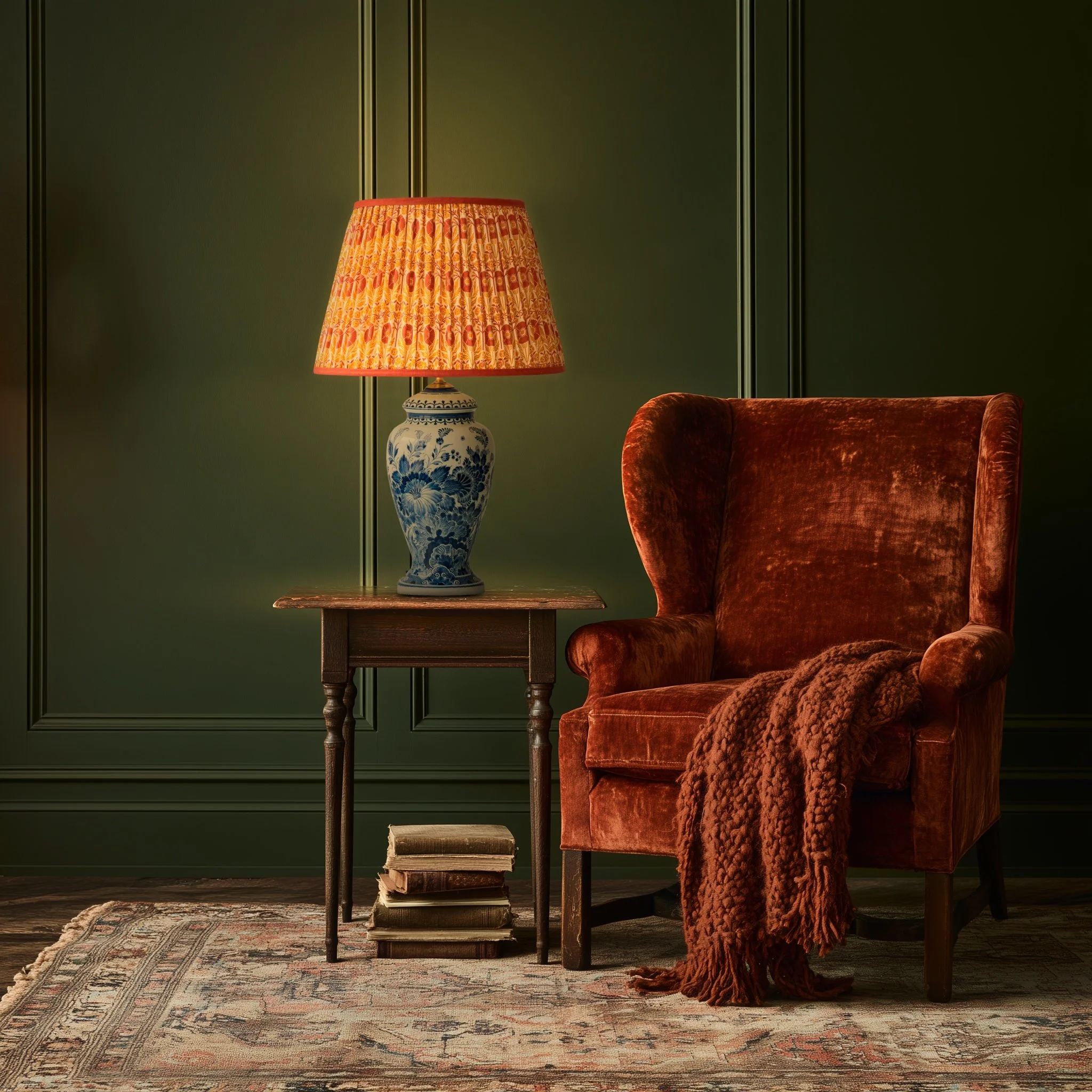
A vintage Delft blue table lamp by Amitābha Studio: burrowcore lighting at its most inviting.
The burrowcore rule is simple: bring the light down low, make it warm and use several sources instead of one. Overhead light flattens a room. Low lamps create pools of glow and soft shadows, and the room feels enclosed and safe, the way a burrow should. Ideal Home sees lighting as the core of the trend. Even if the name fades, warm, cozy lighting comes back every autumn and winter.
1. Switch off the ceiling light
Start by not using the big light at all in the evening. Victoria Robinson, trend expert at Hillarys, advises layering several light sources instead of relying on one overhead fixture. You can then adjust the mood through the day (Ideal Home). As a starting point, aim for at least three lamps in a living room, placed in different corners and at different heights.
2. Bring light down to eye level
Table lamps do most of the work in a burrowcore room. Julian Page, head of design at BHS, recommends low accent lamps at eye level on a bookshelf or beside a reading chair. They give a focused, warm glow. Put a lamp wherever you sit, read or pass in the evening: side tables, a console, a chest in the hall, the end of a kitchen counter.
3. Choose shades that glow
The shade decides how a lamp's light feels. Fabric shades diffuse the bulb into a soft glow and cut glare, which is exactly what burrowcore needs. House Beautiful lists fabric lampshades among the natural materials that define the look. Pleated shades add texture. Patterned shades in William Morris prints, Liberty florals or vintage sari silk glow like stained glass when lit. Colored fabrics tint the light: deep greens, rusts and golds give an amber warmth. Our guide to choosing the perfect lampshade covers shape and proportion, and our handmade pleated lampshades are made for exactly this kind of light.
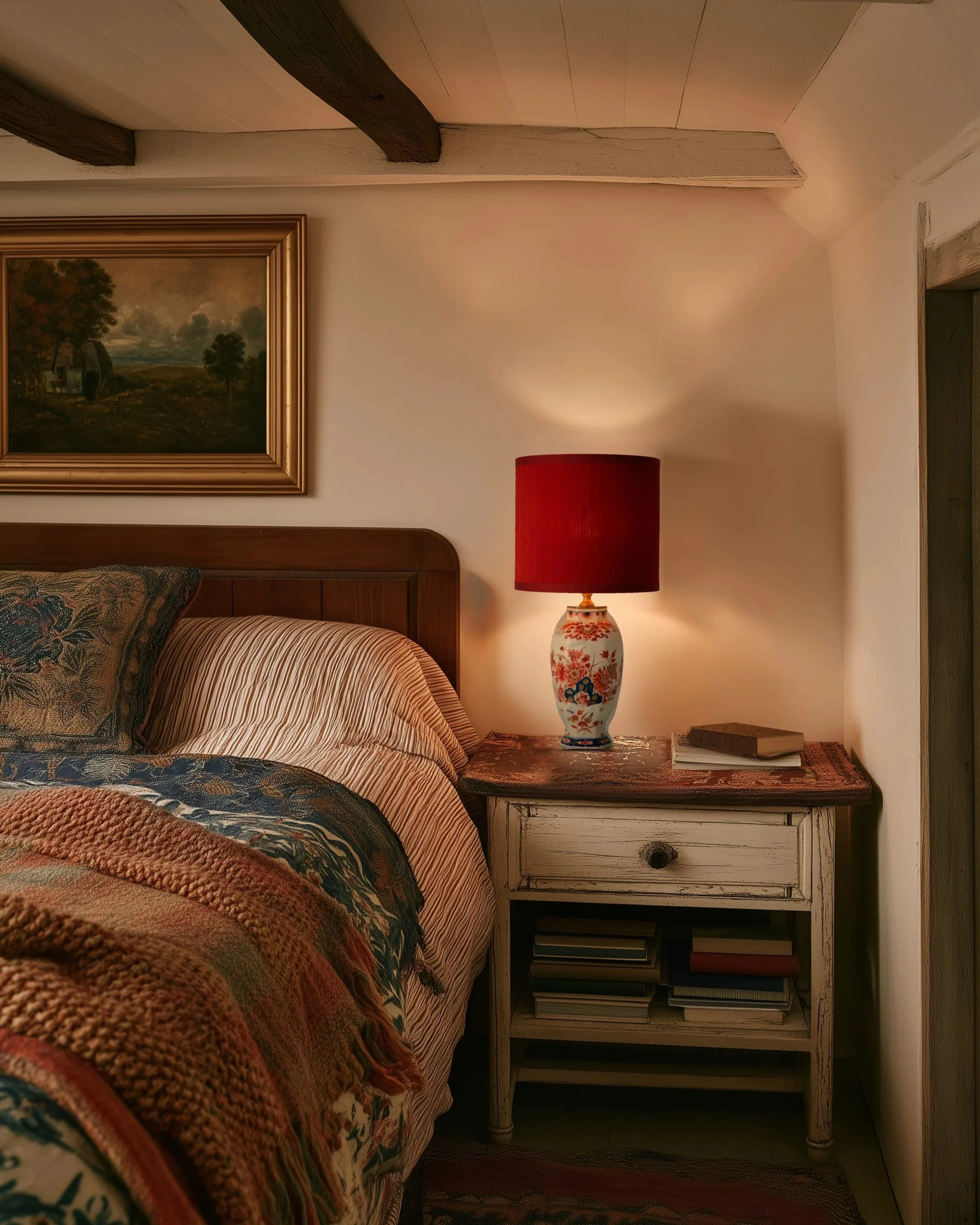
Vintage table lamp by Amitābha Studio from a Royal Delft Imari vase base in a cozy burrowcore bedroom.
4. Use warm, frosted bulbs
Bulb color matters as much as the lamp. Designer Lauren Covino-Smith favors dimmed 2700K lighting for burrowcore rooms (Homes & Gardens). For evenings, try 2200K–2700K. Lower numbers give a warmer, more candlelit glow. Choose frosted or opal bulbs over clear ones, and add dimmers or smart bulbs where you can. Our guide to indoor lighting explains color temperature in more detail.
5. Let the base tell a story
In a burrow, everything on display has a history: the teapot, the jug, the books. A ceramic lamp base does the same job. A hand-painted Spanish vase, a Gouda amphora or a piece of antique Delftware reads as a treasured object even when the lamp is off. When it is on, the light picks out the glaze. Look for bases in earthy glazes, botanical painting or folk motifs. They sit naturally among the crockery and books of a burrowcore room.
6. Mix, don't match
Burrowcore rooms are collected, not coordinated. Pair lamps of different heights and origins, or a vintage base with a newer shade. Mismatched lamps make a room look built up over years, and the 2027 forecasts point the same way, toward collected interiors over matching sets.
The Elements of Burrowcore Style
Burrowcore is built from earthy color, soft texture and objects with a past. You rarely need new furniture. Most of the look comes from layering what you already have. Helen Ashmore, senior design director at Laura Ashley, describes it to House Beautiful as layering tactile textures, aged woods, vintage pieces and nature-inspired prints in warm, earthy tones.
Colors: earth, moss and firelight
The burrowcore palette comes from the forest floor and the hearth. Designers quoted by Homes & Gardens name moss, olive, tobacco, rust and burgundy, and ochre and terracotta belong here too. Many burrowcore rooms are color-drenched, with walls, woodwork and ceiling in one deep shade so the room wraps around you. The timing is good: several 2027 Colors of the Year are in exactly this family, including Behr's mossy olive Grounded and Benjamin Moore's Webster Green. For help building a palette, see our guide to choosing an interior color palette.
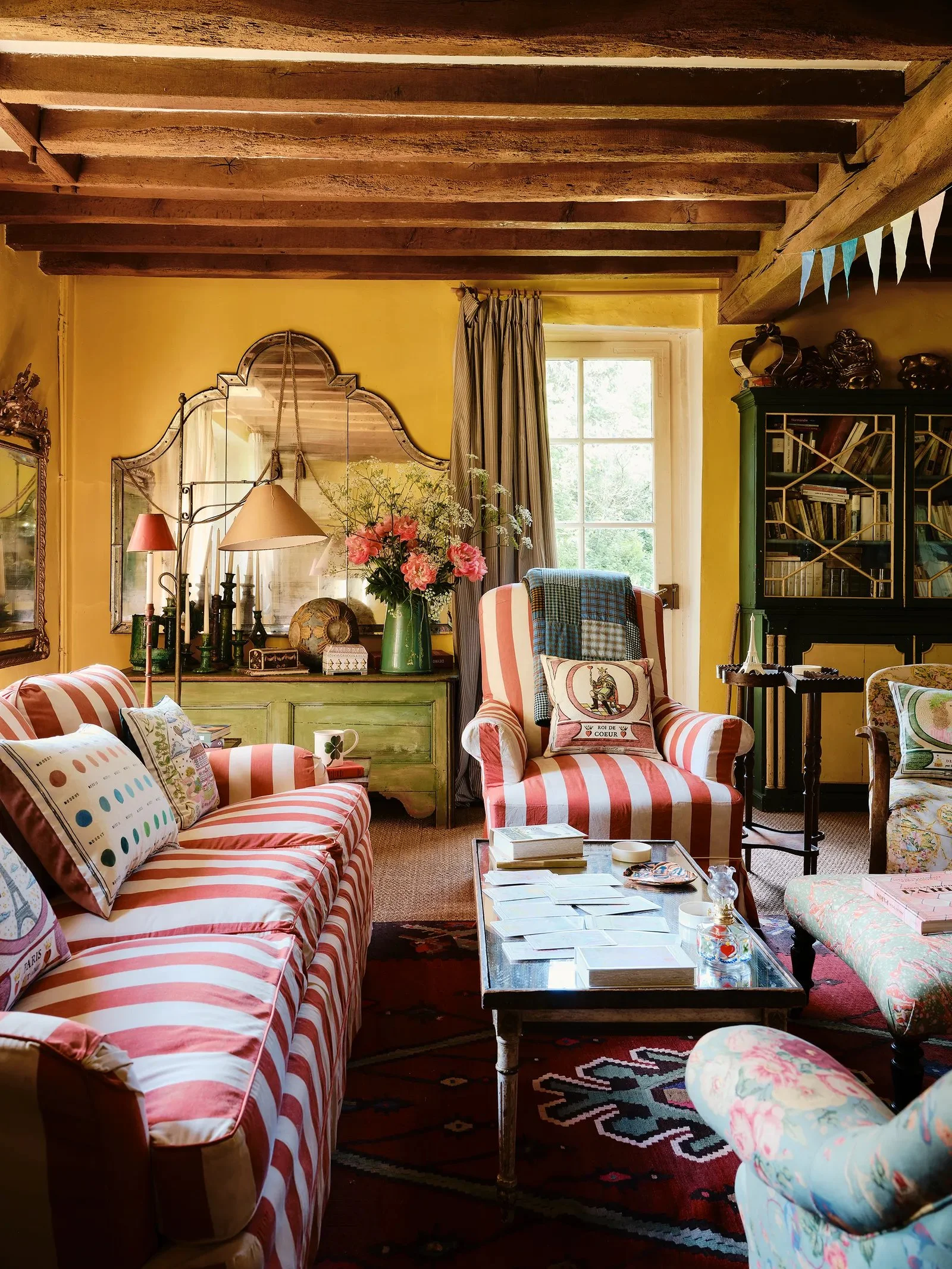
Burrowcore with a French accent: warm yellow walls, red-and-white striped upholstery and layers of collected treasures in French designer and illustrator Marin Montagut's 19th-century Normandy cottage. Photograph: Dean Hearne for House & Garden.
Textiles: soft, heavy and layered
Think chunky wool throws, chenille, brushed cotton, patchwork quilts, layered rugs and heavy curtains that soften both light and sound. Cushions in faded florals, checks and paisleys can all share one sofa. Burrowcore likes pattern on pattern, as long as the colors stay warm.
Wood and furniture: worn, inherited, found
Dark, worn wood is the backbone of the look: a scrubbed pine table, a painted dresser, a bookcase that has moved house five times. Deep armchairs, window seats and built-in nooks give you places to curl up. Flea-market and inherited pieces are better than new, which also makes burrowcore one of the most sustainable ways to decorate.
Ceramics: crockery on display
In the storybooks, the dresser is always full: teapots, jugs, mixing bowls and plates on show. Burrowcore kitchens follow suit, with handcrafted crockery and floral designs kept in view (Ideal Home). Hand-painted earthenware such as Spanish Fajalauza and Talavera, Dutch Gouda and Makkum faience suits the look perfectly. It brings color, folk pattern and the mark of the maker's hand. A ceramic table lamp is the natural next step: crockery that glows.
Books, collections and a little clutter
Stacked books, framed pictures, baskets, dried flowers, collections on a mantel. Burrowcore accepts a lived-in muddle in exchange for comfort. The rule is warmth, not tidiness: every object should feel chosen and loved.
Burrowcore Lighting Ideas, Room by Room
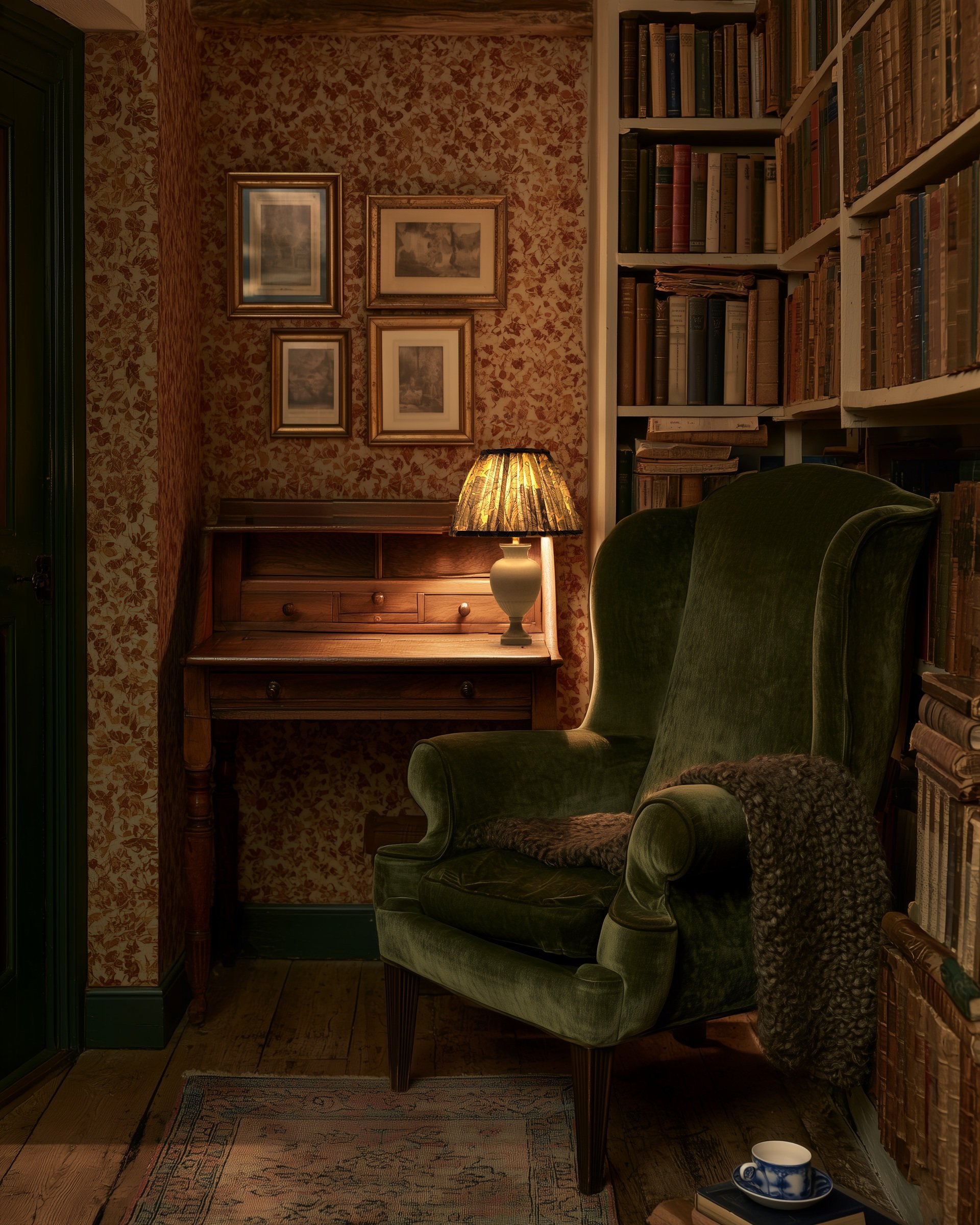
Vintage table lamp by Amitābha Studio with a William Morris pleated lampshade in a cozy burrowcore reading nook.
Every room needs one lamp where you sit and one more to soften the corners. Here is how we would light each space, with lamps from our studio that suit the look.
The living room: a ring of warm light
Set lamps around the room so the seating sits inside a ring of light: one on each side table, one on a console or bookcase, and a floor lamp behind the deepest chair. Balance it with a smaller lamp of a different shape across the room. Browse our Spanish lamps for earthy, hand-painted bases.
The reading nook: one perfect lamp
A window seat, an armchair under the stairs, a corner of the bedroom: a burrowcore nook needs one lamp at shoulder height and nothing else.
The kitchen: a lamp among the crockery
A lamp on the kitchen counter or dresser is the most storybook move you can make. It turns the end of the day into an evening by the hearth. Choose a base that looks at home among jugs and bowls.
The bedroom: mismatched bedside lamps
Bedside lamps should sit low enough that the shade's lower edge is roughly at eye level when you sit up in bed. Skip the matching pair. See our vintage lamps for more mid-century Gouda pieces.
The hallway: a welcome glow
A small lamp on a hall chest is the first thing you see when you come home, and it makes the whole house feel lived in. Choose something with presence but a modest footprint. For antique pieces with real age, see our antique lamps.
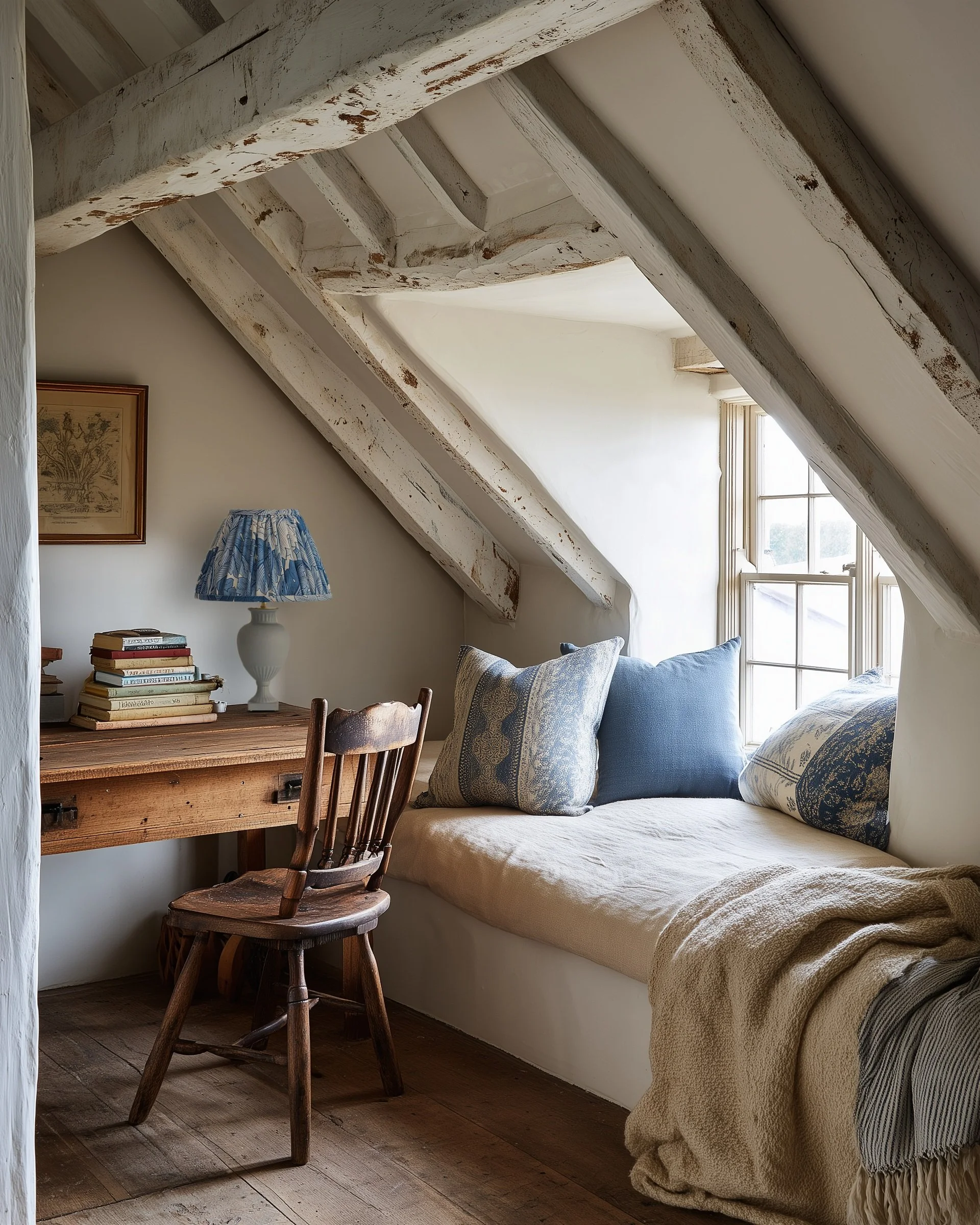
Vintage table lamp by Amitābha Studio with a William Morris pleated lampshade in a cozy burrowcore attic nook.
Burrowcore FAQ
What is burrowcore?
Burrowcore is an interior design trend inspired by the cozy underground homes of storybook animals, such as those in Beatrix Potter and Brambly Hedge. It uses earthy colors, worn wood, layered textiles, collected objects and low, warm lamplight to make a home feel sheltered and lived-in.
What is the difference between burrowcore and cottagecore?
Cottagecore is bright, airy and focused on the outdoors: gardens, daylight, linen and wicker. Burrowcore turns inward. It is darker, more enclosed and built around warm lamplight, deep colors and heavy textiles. Cottagecore suggests a country cottage. Burrowcore suggests the cozy den inside it.
What lighting is best for burrowcore?
Several low, warm light sources are best. Use table lamps with fabric shades at eye level, a floor lamp by the sofa and candles. Avoid bright overhead lights. Choose frosted bulbs of 2700K or lower, and add dimmers so you can lower the light in the evening.
What colors are burrowcore?
Burrowcore colors are earthy and warm: moss, olive, ochre, terracotta, rust, tobacco brown and burgundy. Many burrowcore rooms are color-drenched, with walls, trim and ceiling painted in one deep shade so the room feels enveloping.
Is burrowcore just a fall trend?
Interest in burrowcore surged in autumn 2026, but its ideas outlast any season. Warm lamplight, natural materials and collected, meaningful objects have made homes feel comfortable for centuries. In summer, lighten the textiles and keep the lamps.

Burrowcore for little ones: patchwork gingham quilts, striped headboards and a dark-planked wall under the eaves in Sienna Miller's centuries-old English cottage, decorated with her friend, Gaby Dellal. Photograph: Simon Upton for Architectural Digest. Styling: Sara Mathers.
Make Your Home a Burrow
You don't need a cottage, a fireplace or a renovation to live in a storybook. Turn off the overhead light, bring in three or four warm lamps and let them glow over the things you love: books, crockery, quilts, the chair you always end up in. That is burrowcore.
Each Amitābha Studio lamp is handcrafted from a one-of-a-kind antique or vintage European vase and paired with a bespoke shade. It is made to be the warm, storied light at the heart of a room. Explore our table lamps to find the one that belongs in your burrow!