Gouda Pottery: Discover Its Timeless Beauty and Rich History

Page from Daniel Harkink’s notebook from the book Made in Holland: The Global Success of Dutch Ceramics
Let’s dive into another beautiful Dutch art form: Gouda pottery. Like Delftware, Gouda pottery is a style of Dutch applied art with a fascinating history. It gets its name simply because many factories working in this style were in Gouda, mainly due to the fact that the area was rich with clay. Many designers actually moved to Gouda to work in these factories.
Although originally Gouda pottery factories primarily made clay pipes, they rapidly expanded to make all sorts of decorative pieces, including vases, jugs, plates, and more. At the height of its popularity in the first half of the 20th century, Gouda pottery was shipped all over the world in the millions.
As an applied art, Gouda pottery was used practically and was common in Dutch homes—now, we recognize it for its unique appearance and fascinating history, making it a collector’s item today, rather than a utilitarian object.
A Pioneer Company of Gouda Pottery: Plateelbakkerij Zuid-Holland

Mosaic on outside of PZH
Gouda pottery, at its peak, was largely championed by the company Plateelbakkerij Zuid-Holland, also known as Plazuid or PZH, which was hugely popular from 1900–1920.
Founded in 1898, they primarily made Art Nouveau and Jugendstil style pottery for their first twelve years, which was in vogue. However, they had the vision of introducing a new style to shake up the market and to satisfy the changing tastes of the public, which they achieved in 1909 with the introduction of a “matte-glaze” technique. This was a big shift in both PZH as well as Gouda pottery as a whole—in fact, Gouda pottery is often known for its appearance after 1909.
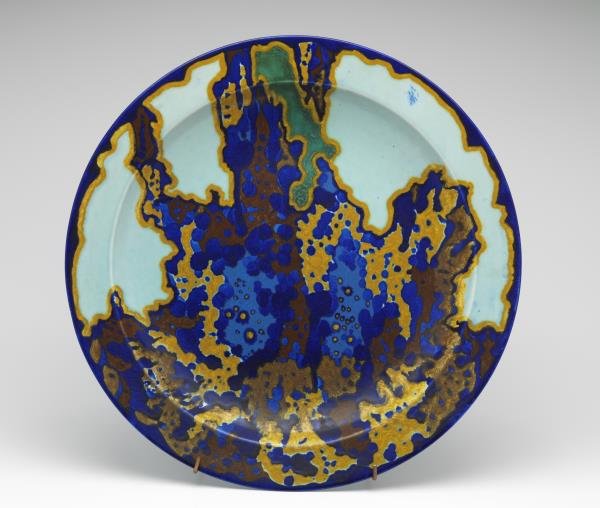
Wall Plate with Abstract Decor by Henri Breetvelt (designer), 1921, Gouda, NV Plateelbakkerij Zuid-Holland (factory) from Museum Gouda
Although it is a somewhat straightforward idea, matte-glaze was a definite shift in style. Basically, what was formerly high-gloss was now finished with a matte look, making for a softer aura of the entire piece (which is part of why, as we’ll get to later, it made for wonderful interior decor).
The matte-glaze technique came at a time when Art Nouveau was waning in popularity and factories—especially PZH—were looking for a new product. Along with the matte-glaze, PZH also introduced new shapes and patterns (which we’ll get to below). These qualities together form the most iconic Gouda pottery.
These inventive techniques propelled the company to fame and immediately set it apart from competitors such as the Rozenburg factory based in the Hague. At PZH’s peak in 1920, they had roughly 300 people employed at the company and were very well-known.
Unique Patterns of Gouda Style Pottery

Page from Daniel Harkink’s notebook from the book Made in Holland: The Global Success of Dutch Ceramics
So, what exactly makes Gouda pottery special visually? There’s a lot of stuff that goes into it—and like most art, you’ll be able to notice and enjoy its beauty when just spending some time exploring the pieces themselves.
Gouda’s inventive designs are largely thanks to Daniel Harkink, a well-known artisan in his time. Already a celebrated designer (he actually previously worked for PZH’s rival, Rozenburg) Harkink set out to invent a new style that come in fashion following the decline of Art Nouveau.
Harkink had an interest in the ceramic art of ancient cultures, so when he was brainstorming ways to invent a new style, these were major influences on his thinking—there’s actually a surviving sketchbook of his illustrating this. As far as shapes, he was inspired by antique Cypriot pottery that he saw in a museum publication. So, part of what makes Gouda pottery so interesting is the influence from ancient art forms—Persian/Iznik, Cypriot and Rhodian designs are all identifiable in it in various features.
For design, Harkink was looking to “Persian” pottery (now we know it as pottery made Ottoman Empire Turkey in the city of Iznik in the 15th and 16th centuries). For example, when you’re looking at Gouda pottery, some of the blue patterns are examples of this influence.
These influences also lent themselves to how Gouda pottery was marketed—they were initially categorized as either “Old Holland” or “Damascus”. Damascus referred to Persian-inspired design, featuring many blues, golds, and flowy floral elements.
Later, “Rhodian” pieces were introduced. These were characterized by extremely rich colors—the palette of rich reds, blues, and greens filled the pottery’s surfaces and was again a new decorating technique. Rhodian pieces are some of the most recognizable Gouda pieces nowadays.
Why Gouda Pottery Makes For Great Interior Decor

Lidded Vase by Henri Breetvelt (designer), 1921, Gouda, NV Plateelbakkerij Zuid-Holland (factory) from Museum Gouda
As we mentioned, with the matte-glaze ware specifically, PZH emerged as a trendsetter for public taste and people appreciated its unique designs. While the pieces are often very brightly colored, the matte-glaze technique makes it more subtle. Ever since it was created, Gouda pottery has been praised as a beautiful and easy addition to any interior.
Here’s just one documented remark from the time regarding its unique ability to blend into any room: “All you have to do is show it; it shows itself.” Additionally, the big department store, Wannamaker’s in America advertised Gouda pottery as the “ideal wedding gift” due to its ability to easily complement any interior, specifically because of its soft appearance and color palette.
That having been said, when you look over the many interesting patterns, colors, and compositions of these pieces, you can see these qualities for yourself. Additionally, Gouda pottery pieces are signed on the bottom by the person who painted them, making for a particularly fascinating bit of history in your home.